Could the nuc with better insulation still be the wrong choice for your apiary? That’s the practical question behind poly nuc vs wooden nuc uk: poly can help buffer temperature changes, while wood may suit beekeepers who prefer a traditional timber box. Neither material is automatically best for every colony or season.
When weighing colony needs against weight, durability and upkeep, look beyond the material label. Frame fit and moisture management matter too. The right choice depends on how you plan to use the nuc, where it will sit, how often you’ll move it and how you’ll clean and store it.
This guide compares insulation, ventilation, everyday handling, cleaning and maintenance, then applies those considerations to jobs such as temporary housing and moving colonies. Before buying, you’ll also learn how to check frame format and compatibility with the hive you plan to transfer into. Use the checks to match equipment to your bees, apiary conditions and plans, rather than choosing on material alone.
Key Takeaways
- For poly nuc vs wooden nuc uk, start with the job the nuc needs to do, not the material alone.
- Consider insulation, ventilation and moisture together. The design and your management both affect conditions inside the box.
- Compare weight, cleaning and repair requirements with how you’ll handle and store the nuc.
- Check the frame format and hive-system fit before ordering, so you can plan a colony transfer without discovering a mismatch later.
- Use a checklist covering intended use, compatibility, care instructions and manufacturer guidance before you choose.
Poly nuc vs wooden nuc: what is the difference for UK beekeepers?
A nuc is a compact box used to house a small bee colony. The term can also refer to the colony itself, a nucleus colony (nuc). Material is one part of choosing a box. Frame format, construction, ventilation and the task you need it for also affect whether it will suit your apiary.
For a useful poly nuc vs wooden nuc uk comparison, begin with the general differences below, then check the specifications of the exact model you’re considering. Features such as floors, roofs and feeders depend on the design. They are not guaranteed characteristics of every poly or wooden nuc.
| Factor | Poly nuc | Wooden nuc |
|---|---|---|
| Insulation | Generally provides more thermal insulation than timber. | Generally offers less insulation than poly; construction and thickness vary. |
| Weight | Usually lighter, which can make handling and transport easier. | Often heavier, depending on timber and construction. |
| Care | Cleaning and storage instructions vary by product; avoid damaging the surface. | May need care to protect timber from weathering; follow the maker’s guidance. |
| Durability | Can be vulnerable to knocks or damage from hive tools. | Durability depends on timber, build quality, use and storage. |
| Compatibility | Must match the intended frame format and hive system. | Must also match the frames and hive you plan to use. |
What distinguishes a poly nuc from a wooden nuc?
Poly nucs are moulded from insulating plastic material. Expanded polystyrene is common, but designs can use other materials, so check the product specification. Wooden nucs are made from timber, with board thickness, joints and finish varying between designs. Neither material guarantees effective ventilation or suitable colony conditions. Check how the specific nuc is ventilated and manage it appropriately for the bees and season.
Handling and upkeep are practical trade-offs, not just specification-sheet details. A lighter box may be easier to move, while a poly surface can be more susceptible to tool damage. Timber can be robust, but its service life depends on construction and care. For either material, follow the maker’s cleaning and storage instructions.
Why does the intended use matter?
Swarm control, queen mating, colony growth and overwintering can place different demands on a nuc. If you’ll use it briefly and move it often, weight may matter more. If it will stay in place longer, insulation, frame fit and ongoing care may deserve more attention. There’s no universal winner. Match the box to its purpose, then confirm that its frame dimensions and format suit the hive it will serve.
If you’re choosing a colony as well as its housing, the UK honey bee nuc buyer’s guide covers the wider purchase decision. BS Honey Bees supplies 2-in-1 poly nucs. Check the current specifications and compatible formats before deciding whether one suits your setup.
Poly nuc insulation, ventilation and moisture: what should you weigh?
Insulation, ventilation and moisture are connected, but they are not interchangeable. Insulation slows heat exchange through a box’s walls. Ventilation concerns how air moves through the nuc. Moisture management depends on the design and on how the box is set up and managed. In short, insulation affects heat transfer, while ventilation helps govern airflow. Pay attention to both because temperature and moisture conditions interact.
Does a poly nuc keep a colony warmer?
Poly construction generally insulates more effectively than timber, so less heat moves through the box walls. That’s a material property, not a promise about colony growth or winter survival. Conditions depend on the full setup and the bees, not the wall material alone.
Read the manufacturer’s guidance for the specific nuc before choosing. Consider colony strength, site exposure and local winter conditions when planning seasonal management. A sheltered apiary and an exposed site can present different challenges, so a general material comparison cannot replace an assessment of your own conditions.
How should beekeepers think about ventilation and condensation?
Bees produce heat and moisture within the colony. Moist air can condense on cooler surfaces, but whether this becomes a concern depends on factors such as the nuc’s construction, airflow and management. Poly does not automatically mean poor ventilation, and wood does not automatically prevent damp. Check the design instead of making assumptions based on the material.
Inspect the entrance, floor and cover on the model you’re considering. Identify which parts provide ventilation, whether openings can be adjusted and what the manufacturer recommends for different seasons. Don’t routinely seal openings or add extra ventilation without a sound reason, as either change may affect conditions inside. For practical husbandry information, consult resources from the British Beekeepers Association and adapt your approach to the colony and site.
Winter preparation also depends on colony strength, exposure and your established beekeeping practice. Consider these alongside insulation, and use reliable, evidence-based guidance if you’re unsure how to manage ventilation or moisture. No single setup suits every apiary.
BS Honey Bees supplies 2-in-1 poly nucs. Check the current specifications, compatible frame format and manufacturer guidance to see how a model fits your equipment and seasonal plans.
Wooden vs poly nucs: how do durability, handling and maintenance compare?
Weight, cleaning and storage can matter as much as insulation, particularly if you move nucs regularly or have limited space. Poly nucs are generally lighter than wooden ones, but the difference depends on the model and its fittings. Check the manufacturer’s stated weight, including any feeder or removable parts, before planning transport or lifting.
Which nuc is easier to move, store and maintain?
Consider how often you’ll carry the box, where you’ll store it and whether it needs to stack with your other equipment. Lighter equipment may be easier to handle, while timber construction can feel more substantial. Neither material is automatically simpler to maintain. Cleaning methods vary by material and model, so follow the maker’s instructions rather than applying a familiar method to unfamiliar equipment. Check whether the nuc needs particular protection during storage.
How can you assess durability before choosing?
Look beyond the material label. Inspect the joints, edges, lid, floor and fittings, then consider how you’ll use and store the box. Timber quality and construction affect how well a wooden nuc withstands wear. Poly can be damaged by knocks or careless use of hive tools. Durability and service life depend on the build, handling and care, so don’t rely on broad claims or one beekeeper’s experience.
Check the smaller components too. A report about a feeder or fitting on one model doesn’t show that all poly nucs share the same fault. Treat forum comments as prompts to ask which model was involved, what part failed and whether a replacement is available. Confirm that replacement parts fit the nuc and work with your intended management system.
- Before buying: compare the stated weight and dimensions of the exact models.
- For storage: check stacking arrangements, space requirements and any protection recommended by the maker.
- For cleaning and repair: ask which methods are suitable and whether damaged parts can be replaced.
- For fittings: confirm that feeders, floors and lids are compatible with the model. Don’t assume designs are interchangeable.
Decision rule: compare care requirements and replacement parts for the exact model, not just whether it’s poly or wood. This makes the poly nuc vs wooden nuc uk choice more relevant to your routine. A nuc that’s straightforward for you to store, clean and repair may be a better fit than one chosen on material alone.
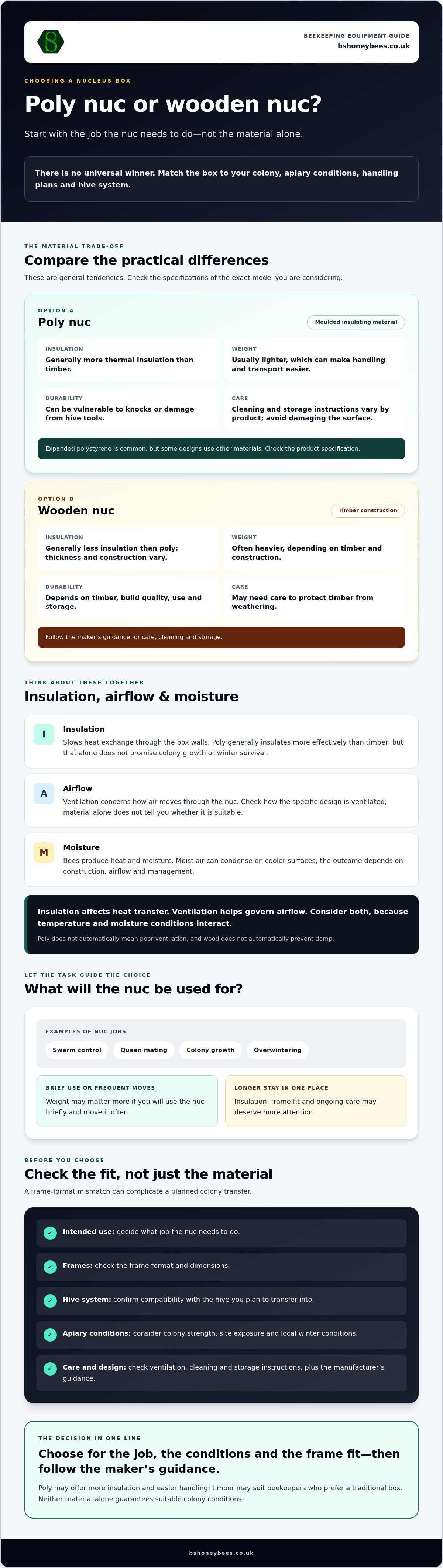
How to choose a nuc for your apiary, frames and beekeeping plans
Choose a nuc around the job it needs to do and the equipment you already use. A box intended for short-term transport may have different priorities from one for colony expansion or queen work. Before ordering, work through these four checks:
- 1. Define the job. Decide whether the nuc is for temporary housing, colony growth, queen work or another purpose. Consider how long you expect to use it and how often it may need moving.
- 2. Check compatibility. Compare the frame format and dimensions with your existing frames and the hive the colony will move into. Don’t assume that boxes described as the same frame type will fit without checking the product details.
- 3. Assess handling and storage. Think about the route from storage to apiary, how often you’ll carry the box and where it will be kept between uses. Compare the stated weight and dimensions of the exact model.
- 4. Review care instructions. Check how the manufacturer recommends cleaning, storing and maintaining the nuc, and whether replacement parts are available if a fitting is damaged.
Which checks prevent a compatibility mistake?
Start with the frames, not the material. Confirm the nuc’s stated frame format and dimensions, then check that the frames sit correctly in the box and suit the hive system you plan to use. If the product description mentions conversion parts or other requirements, clarify them before buying.
Check what’s included as well. Floors, feeders, covers and other accessories can vary between models. Verify whether each item is supplied or needs to be sourced separately, and make sure any add-ons are intended for that particular nuc. If you keep British National equipment, the British National beehive guide provides useful context for your hive system.
Which material may suit different beekeeping jobs?
There’s no single material choice for every apiary. If you move equipment frequently, portability may carry more weight in your decision. If you plan longer-term use, you may focus more on insulation, maintenance and available storage. Consider these factors alongside your management plan rather than treating poly or wood as a complete answer on its own.
For colony-management questions, ask an experienced member of a beekeeping association. For equipment, check the maker’s specifications and compatibility information. If a 2-in-1 poly nuc suits your plans, explore the available 2-in-1 poly nuc option and confirm its current frame format and features before ordering. Checking these details is a practical way to resolve the poly nuc vs wooden nuc uk decision for your setup.
Choosing between a poly nuc and wooden nuc: a confident next step
There’s no universal winner. Poly may appeal if lower weight or insulation is a priority, while wood may better suit your preferences for construction and care. Material alone won’t tell you whether a nuc will work in your apiary. Design, frame fit, intended use and management all count.
To settle the poly nuc vs wooden nuc uk question, compare the specifications of the exact models you’re considering, then match them to your equipment and plans.
What is the simplest way to make your final decision?
Start with one defined task, such as temporary housing, colony expansion or queen work. If you expect the nuc to serve several purposes across the season, check each requirement rather than assuming one model will suit every job equally well. Compare confirmed dimensions, fittings, care guidance and handling details instead of relying on general claims about a material.
- Intended use: What will the nuc do, and for how long?
- Compatibility: Do its frame format and dimensions match your equipment?
- Care: Can you follow the cleaning, storage and maintenance guidance?
- Handling: Are its weight and size practical for your apiary routine?
- Manufacturer guidance: Have you checked the instructions for the exact model?
When should you ask for more product information?
Ask the supplier to confirm frame dimensions, compatible hive systems and which fittings are included. If anything is unclear, request the current care and cleaning instructions for that specific nuc before ordering. Keep equipment questions separate from colony-health concerns. For management advice, consult a suitably informed beekeeping source.
BS Honey Bees Ltd supplies 2-in-1 poly nucs, an option to consider if the format and intended use suit your plans. Check the current product details and compatibility before choosing. To compare equipment options, explore the beekeeping equipment range.
Choose the nuc that fits your next step
The right choice in the poly nuc vs wooden nuc uk decision depends on the job, not just the material. Poly offers greater insulation and is generally lighter, while wooden nucs may suit different handling and care preferences. Neither is automatically best for every apiary.
Before buying, confirm the frame format and dimensions, check that the nuc suits your hive system and review its care instructions. Consider how often you’ll move it, where you’ll store it and whether its design meets your intended use. Ventilation, construction and management matter alongside material, so check the specifications for the exact model.
BS Honey Bees Ltd supplies 2-in-1 poly nucs as well as British National hives and frames. Check compatibility before choosing equipment, then explore BS Honey Bees’ beekeeping equipment to consider the options for your apiary.
With a clear purpose and a few careful checks, you can choose equipment that fits your beekeeping plans.
Frequently Asked Questions
Is a poly nuc better than a wooden nuc for overwintering?
Not automatically, although poly generally offers more insulation than timber. In the poly nuc vs wooden nuc uk comparison, treat insulation as one factor, not a guarantee of winter survival or colony health. Colony strength, exposure, ventilation, equipment design and beekeeper management also matter. Check the manufacturer’s winter guidance for the exact model and assess your apiary conditions before choosing or preparing a nuc for overwintering.
Can wooden and poly nucs use the same frames?
Only if the nucs are designed for the same frame format and dimensions. Material alone doesn’t determine compatibility. A poly nuc and a wooden nuc may both be made for British National frames, for example, but confirm the specifications rather than relying on the label. Check that the frames sit correctly and that the nuc will work with the hive you plan to transfer them into. Ask about conversion requirements if the product details are unclear.
Do poly nucs need ventilation?
Yes, the colony needs suitable airflow, but how a particular poly nuc provides it depends on its design. Check the entrance, floor and cover, and follow the manufacturer’s guidance for that model. Don’t assume every nuc needs extra openings or that existing vents should be sealed. Either change can affect airflow and moisture conditions. If you’re unsure how to manage ventilation for your colony or season, seek advice from a reliable beekeeping source.
How do you clean and maintain a poly nuc?
Follow the manufacturer’s cleaning and care instructions for the exact nuc. Designs and materials vary, so don’t assume a method suitable for one box is appropriate for another. Inspect the surface, edges, joints, floor and fittings for damage, and handle the box carefully because poly can be vulnerable to knocks or hive-tool damage. Store it as directed and check whether replacement parts are available before you need them.
Are wooden nucs more durable than poly nucs?
Not in every case. A well-built wooden nuc can be robust, while poly may be more susceptible to impact or damage from tools. Durability also depends on construction quality, how often the nuc is moved, storage conditions and ongoing care. Inspect the joints, edges, lid, floor and fittings on the specific model. Compare its care instructions and replacement-part options instead of judging service life from material alone.
Which nuc should a beginner choose in the UK?
Choose a nuc that fits your frames, hive system and intended use rather than assuming one material is best for every beginner. Confirm frame dimensions and included fittings, then consider how you’ll move, store and maintain the equipment. A nuc that matches the rest of your apiary can make planning a colony transfer simpler. For colony-management questions, ask an experienced beekeeper or beekeeping association member for guidance.
Can a poly nuc be used for swarm control and queen mating?
It can be suitable for these jobs if the particular design, capacity and frame format meet your needs. Swarm control and queen mating are different tasks, so check what the nuc is designed to hold and how its fittings support your intended setup. Don’t assume every poly model is interchangeable or suitable for both purposes. Read the product specifications and manufacturer guidance before use, and seek beekeeping advice if you’re uncertain about management.