Checking for queen cells during inspection starts with distinguishing an empty wax cup from an occupied cell in which a queen may be developing. A cup can look concerning amongst crowded brood, but its presence alone does not mean the colony is about to swarm.
Work methodically and read the evidence in context. The number and position of cells, their visible contents and stage of development, and the colony’s condition all help you understand what may be happening. Swarming is one possibility, but a colony may also be replacing a failing queen or responding to queen loss.
This guide explains how to check frames systematically, distinguish cups from developing queen cells and assess what you find without relying on cell count alone. You’ll also learn what to record and how to choose a sensible follow-up, so you can investigate before acting rather than removing cells in haste.
Key Takeaways
- Make a steady frame-by-frame sweep, checking comb faces, edges and lower margins before moving on.
- During checking for queen cells during inspection, note whether a cell is occupied and developing rather than treating every queen cup as a developing cell.
- Use cell position alongside the brood pattern, queen evidence and colony condition. Location alone doesn’t confirm why cells are present.
- Record the frame and your observations, then assess the colony before deciding what to do next.
- If you’re unsure what the signs mean, pause and seek experienced advice instead of rushing to remove cells.
Why check for queen cells during a hive inspection?
A queen cell is a specialised cell in which a queen may develop. Finding one is a reason to assess the colony, not an automatic instruction to remove it or make another change. Queen cells may be associated with swarming, queen replacement or queen loss, but one structure alone can’t tell you which situation applies.
When checking for queen cells during inspection, consider the wider evidence. Look at the brood pattern, whether eggs or young larvae are present, signs of the queen, and what has happened since your last visit. A recent swarm or a change in the colony’s queen status may help explain what you see. The Development of a Queen Bee provides background on how queen cells are used in these different colony contexts.
What is the difference between a queen cup and a queen cell?
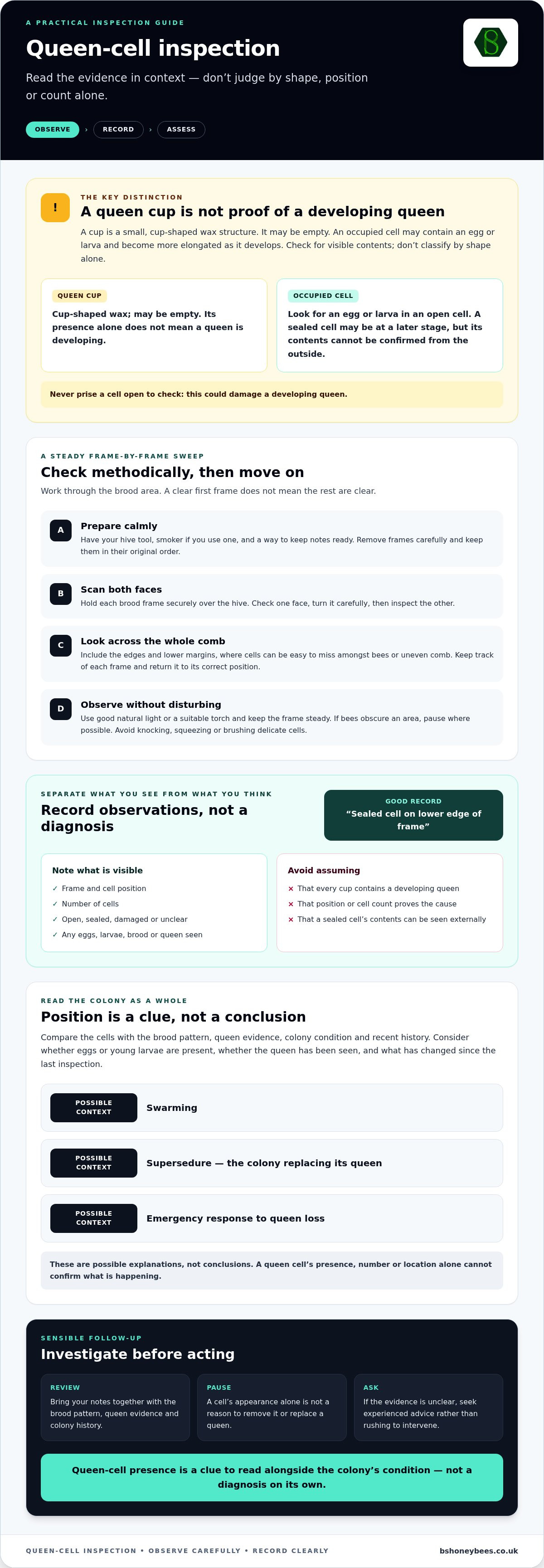
A queen cup is a small, cup-shaped wax structure that workers may build before it contains an egg or larva. It can look like the start of a queen cell, but its presence alone doesn’t show that a queen is developing. An occupied cell may contain an egg or larva and become more elongated as it develops. Check carefully for visible contents; don’t classify it by shape alone or pull it open, as that could damage a developing queen.
Why does a queen-cell check matter to colony management?
A careful check can help you notice signs that may point towards swarming, supersedure, when a colony is replacing its queen, or an emergency response to queen loss. Treat these as possible explanations, not conclusions based on a cell’s position or number. Compare what you find with the brood pattern and the colony’s recent history, then record your observations. If the evidence is unclear, seek experienced advice before intervening.
Queen-cell presence is a clue to read alongside the colony’s condition, not a diagnosis on its own.
How to find and assess queen cells frame by frame
A steady routine makes checking for queen cells during inspection more reliable and helps limit disturbance to the brood. Before opening the hive, have your hive tool, smoker if you use one, and a notebook or other record-keeping method ready. Open the hive calmly, remove frames carefully and keep them in their original order. Work through the brood area rather than stopping as soon as one frame looks clear.
Which frames and areas should you check?
Examine each brood frame in turn. Hold it securely over the hive, scan one face, then turn it carefully to check the other. Look across the comb, including its edges and lower margins, where cells can be easy to miss amongst bees or uneven comb. Keep track of which frame you’ve inspected, and return it to the correct position before moving on. A clear first frame isn’t evidence that the rest are clear.
Take your time, but avoid holding frames out of the hive longer than needed. Use gentle movements and don’t knock, squeeze or brush against delicate cells. If bees obscure an area, pause and allow them to move where possible rather than disturbing the comb to get a better view.
How can you assess whether a queen cell is occupied?
Use good natural light or a suitable torch, and keep the frame steady. Look into an open cell for an egg or larva. A sealed cell may indicate a later stage, but you can’t confirm its contents by looking at the outside. Don’t prise a cell open to check. Note whether it appears open, sealed, damaged or unclear, along with its frame and position. Descriptions of queen development, including the practical discussion in Working with Queen Cells, can help you understand what you’re observing.
Record what you can see, not what you assume it means. For example, write “sealed cell on lower edge of frame” rather than recording a confirmed diagnosis or cause. Also note the number of cells and whether you saw eggs, larvae, brood or the queen. These observations give you a clearer basis for assessment later without risking damage to a developing cell.
If your inspection and subsequent assessment indicate that a queen change may be needed, you can review the F1 Buckfast and Carniolan queen range as one possible resource. First, complete the inspection and weigh the colony evidence. A cell’s appearance alone isn’t a reason to replace a queen.
What queen-cell position and colony clues can tell you
Position can help you form a working theory, but it isn’t a diagnosis. When checking for queen cells during inspection, compare what you see with the colony’s strength, available space, queen evidence and brood pattern. A queen present with eggs and a consistent brood pattern offers different clues from a colony where eggs are absent or brood is patchy. Neither observation should be judged in isolation.
| Possible context | Clues to consider | What to check next |
|---|---|---|
| Swarm preparation | Cells may be found around frame edges or lower margins, alongside a strong, crowded colony. | Assess colony strength, room to expand, queen evidence and other signs of swarming. |
| Supersedure | A small number of cells on the comb face may occur whilst a queen is still present. | Look for the queen, eggs and brood pattern; consider whether the colony may be replacing her. |
| Emergency response | Cells may appear in different places, including on worker brood comb. | Check for queen evidence and eggs, and consider any recent change in the colony’s queen status. |
These are patterns to investigate, not rules. Position and number vary, and local conditions or beekeeping practice can affect how signs are interpreted. If you’re unsure, compare your observations with current UK guidance or ask an experienced beekeeper or association before deciding what they mean.
Could queen cells indicate swarming?
Yes, swarm preparation is one possible reason a colony produces queen cells. But a cell near the bottom of a frame, or several cells together, doesn’t reliably predict that a swarm is imminent. Consider the whole picture: how strong and crowded the colony is, whether it has space, and whether the queen is present. For another practical overview of how to quickly check for swarm cells, compare your frame-by-frame method with Betterbee’s guidance.
Could the colony be replacing a queen?
Supersedure is a possible replacement process whilst the existing queen remains in the colony. Emergency cells, by contrast, may follow queen loss or absence. Check for the queen, fresh eggs and the overall brood pattern, then compare these clues with your recent inspection notes. A weak or irregular brood pattern can have more than one explanation, so don’t conclude that the queen is failing from cells alone. If concerned, review other signs of a failing queen and seek advice before intervening.
What to do after finding queen cells during inspection
Finding a queen cell can make you want to act straight away. Pause first. The right response depends on why the colony may be producing cells, whether a queen is present and what else you observed. A cell’s position or number alone isn’t enough to choose a swarm-control method or decide that the colony needs requeening.
Should you remove queen cells when you find them?
No single response suits every colony. Removing cells without understanding the situation may remove the colony’s opportunity to replace a lost or failing queen. If the colony is preparing to swarm, simply removing cells without addressing the underlying swarming impulse may not prevent a swarm and could leave the hive queenless. Don’t treat cell removal as a complete plan. If you’re uncertain, consult an experienced mentor or reputable beekeeping association, and check current British advice before making a decision with significant consequences.
Use this sequence before choosing a next step:
- Document: Record what you found and where.
- Assess: Consider queen sightings, eggs, brood pattern, colony strength and recent history together.
- Consult: Compare your observations with trusted, current guidance or ask an experienced beekeeper if the picture remains unclear.
- Plan: Decide what to do next, including when to review the colony, in light of its circumstances and reliable advice.
How should you record findings and plan another check?
Make your notes specific enough to compare at the next inspection. Include the date, frame and cell location, the number of cells, whether each appeared open, sealed or damaged, and any contents you could see without disturbing it. Add relevant observations, such as whether you saw the queen or eggs and what the brood pattern looked like. Keep uncertainty in the record too; “contents unclear” is more useful than an unsupported diagnosis.
Don’t rely on a fixed follow-up interval without considering the colony. Appropriate timing depends on what you found and the management plan you’re following, so check current UK beekeeping guidance or seek advice rather than guessing. If your assessment leads you to consider a queen change, consult reliable guidance on introducing a new queen before proceeding. You can also explore F1 Buckfast and Carniolan queens as a possible resource once you’ve concluded that replacement may be appropriate.
Build a confident queen-cell inspection routine
A consistent routine makes checking for queen cells during inspection easier to repeat and your records more useful. You don’t need to identify every situation instantly. Focus on observing carefully, noting what remains uncertain and choosing a sensible next step based on the colony as a whole.
A quick checklist before closing the hive
- Check both sides of each brood frame, including edges and lower margins, and return frames in their original order.
- Record the date, frame and cell location, along with visible contents and whether the cell appears open, sealed or damaged. Don’t open or handle cells unnecessarily.
- Note supporting signs, such as queen sightings, eggs and the brood pattern, as well as any unanswered questions.
- Before closing up, make sure your notes show what you observed separately from what you think it might mean.
That distinction matters. “Queen not seen” is an observation; it doesn’t confirm that the colony is queenless. If queen status is unclear, or you’re unsure what the colony may do next, ask an experienced beekeeper or consult current guidance from a reputable British beekeeping association. Uncertainty is a reason to seek advice, not to rush into removing cells or making a major management change.
When might a beekeeper consider a replacement queen?
Queen cells alone don’t establish that a replacement queen is needed. Consider the broader evidence, including queen presence, eggs, brood pattern and the colony’s history. If that assessment leads you to consider requeening, use a reliable guide to selecting and introducing mated queen bees, and check that its advice suits your circumstances before acting.
If you’ve independently decided that a queen change may be appropriate, you can explore the queen-bee range as one possible resource. Make the management decision first; the presence of a cell, by itself, isn’t a recommendation to replace the queen.
Make your next queen-cell check count
Confident checking for queen cells during inspection comes down to a calm, repeatable process: examine brood frames systematically, distinguish an empty cup from a developing cell, and read its position alongside the colony’s condition. Record what you see, but don’t let cell count or location alone dictate your next move.
If queen status or the likely outcome remains unclear, pause and consult trusted, current British beekeeping guidance or an experienced beekeeper. Careful observation and sound advice are better than a rushed intervention.
If your assessment leads you to consider a queen change, BS Honey Bees Ltd supplies F1 Buckfast and Carniolan queen bees, as well as 5- and 6-frame nucleus colonies. Explore BS Honey Bees Ltd’s queen-bee range if you’re looking for a queen. Make the management decision based on the colony’s evidence and reliable advice, not the presence of a cell alone.
Frequently Asked Questions
What does it mean when you find queen cells during an inspection?
Queen cells may indicate that a colony is preparing to swarm, replacing a queen or responding to queen loss. Their presence doesn’t confirm which situation applies, so consider the colony’s condition, queen sightings, eggs, brood pattern and recent history together. When checking for queen cells during inspection, record where you found them and what you could see. Avoid removing cells or making a major change based on one clue alone.
How can you tell a queen cup from a queen cell?
A queen cup is a small, cup-shaped wax structure that may be empty. An occupied, developing queen cell contains an egg or larva and can become elongated as it develops. Shape alone isn’t conclusive. Look carefully for visible contents without opening or damaging the cell, and note whether it appears open, sealed or unclear. If bees or the angle make it difficult to see inside, record your uncertainty rather than guessing.
Where should you look for queen cells during a hive inspection?
Check every brood frame systematically, looking across both faces, edges and lower margins. Cells can be easy to miss amongst bees or uneven comb, so don’t stop after finding a clear first frame. Keep frames in order as you inspect, and handle them gently to avoid damaging cells. If bees obscure part of the comb, take care and note any area you couldn’t assess clearly rather than assuming it’s cell-free.
Can queen cells indicate that a colony is preparing to swarm?
Yes, swarm preparation is one possible reason for queen-cell production, particularly when considered alongside a strong, crowded colony or limited space. But neither a particular position nor a high cell count proves a swarm is imminent. Check for other signs, queen evidence and the colony’s overall condition. If swarm risk seems possible, use trusted, current UK guidance or seek experienced advice before choosing a management response.
How often should you check for queen cells?
There isn’t one inspection interval that suits every colony and circumstance. Follow a planned inspection routine informed by the time of year, colony condition and current UK beekeeping guidance. During each visit, inspect the brood frames carefully and record your observations so you can compare them with earlier findings. If you’re managing a colony with uncertain queen status or possible swarm preparation, ask a reputable association or experienced beekeeper about appropriate follow-up timing.
What should you do if you find sealed queen cells?
Pause and assess the colony rather than removing sealed cells automatically. Record their locations and number, then consider whether you saw the queen, eggs or a consistent brood pattern, alongside the colony’s recent history. A sealed cell indicates a later stage of development, but it doesn’t by itself explain why it was made or determine the right action. If queen status or likely outcome is unclear, consult current guidance or an experienced beekeeper before disturbing the cells.